PhD Research
1. Data permutation recovery
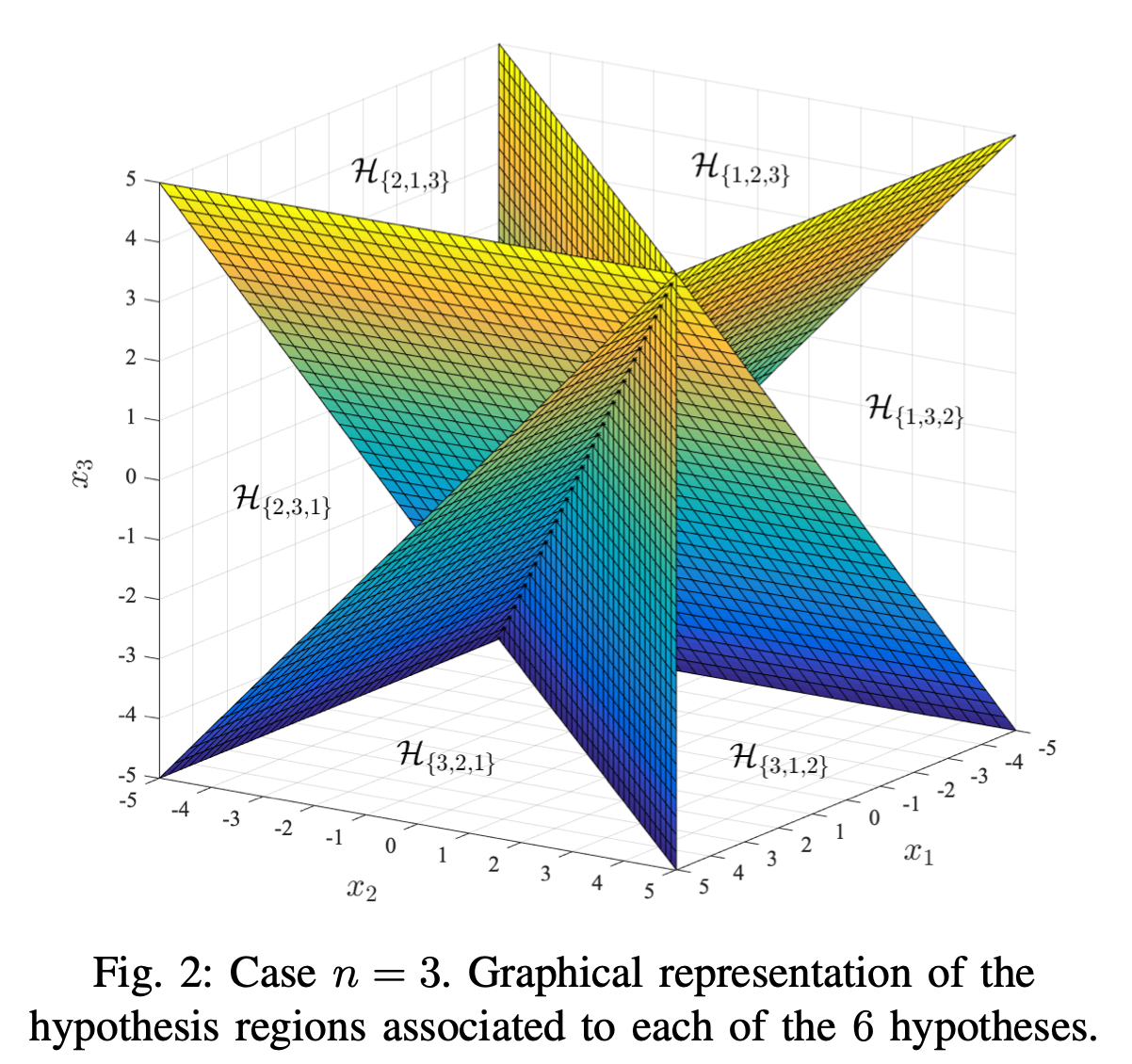
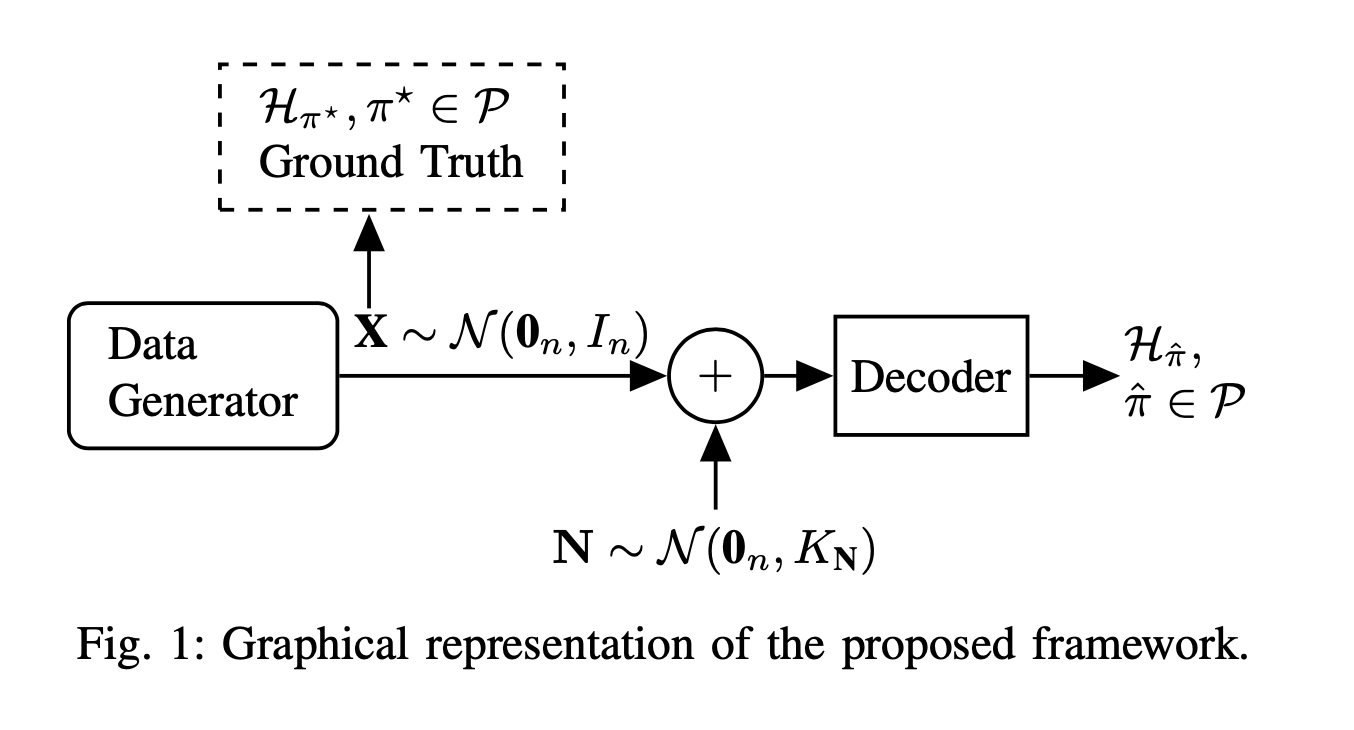
We studied the problem of data permutation recovery. Specifically, the objective to be estimated is the permutation sequence (e.g., index vector indicating how ordered it is) given the noisy observed data. We started by assuming Gaussian distribution for the input and the noise, which is illustrated in here.
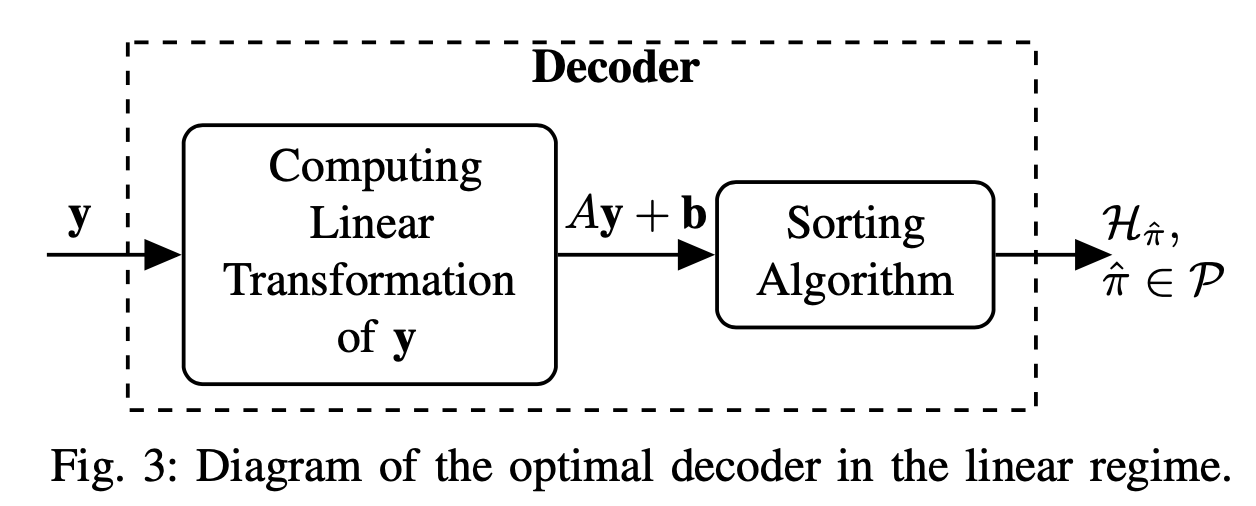
As a result, we fully characterized the linear decoding regime in terms of the noise covariance matrix, and we proposed the necessary and sufficient condition for the linear decoder that performs optimally in the sense of error probability and has polynomial complexity in data length $n$. In particular, the optimal decoding (i.e., MAP decoding) has $n!$ complexity in data length $n$. The decoding consists of linear transformation and sorting function as illustrated in figure. For details, see “Recovering Data Permutations From Noisy Observations: The Linear Regime”.
We are trying to extend this result to the problem with the non-Gaussian distribution assumption, and studying partial recovering permutation sequence instead of full sequence.
2. Differential privacy
Data privacy, particularly differential privacy (DP), is our ongoing research topic. In particular, we are currently studying two sub-topics. The first is to characterize and design the optimal noise adding mechanism satisfying various DP constraints (e.g., $\epsilon$-DP, $(\epsilon,\delta)$-DP, $\epsilon$-Rényi DP, $\epsilon$-mutual information DP, etc). The second is to formulate the problem of data permutation recovery with DP constraints and to study the optimal mechanism, decoder, and probability of error in that problem.
M.S. Research
1. Rate compatible punctured polar (RCPP) code
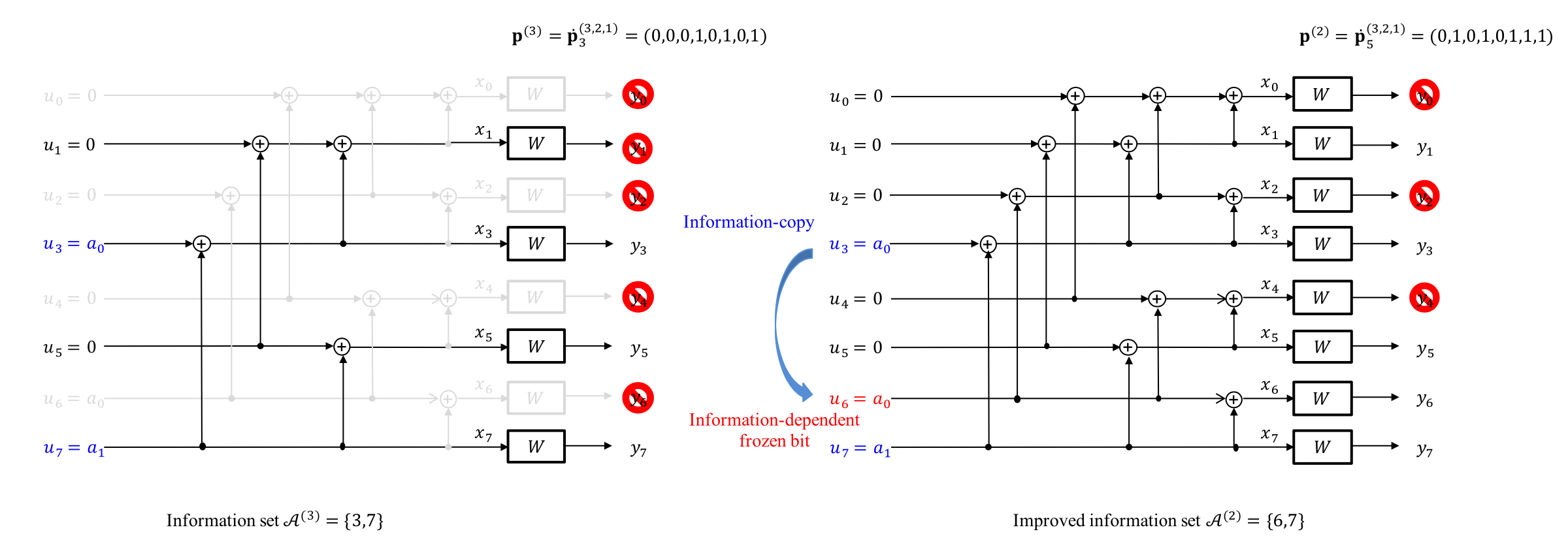
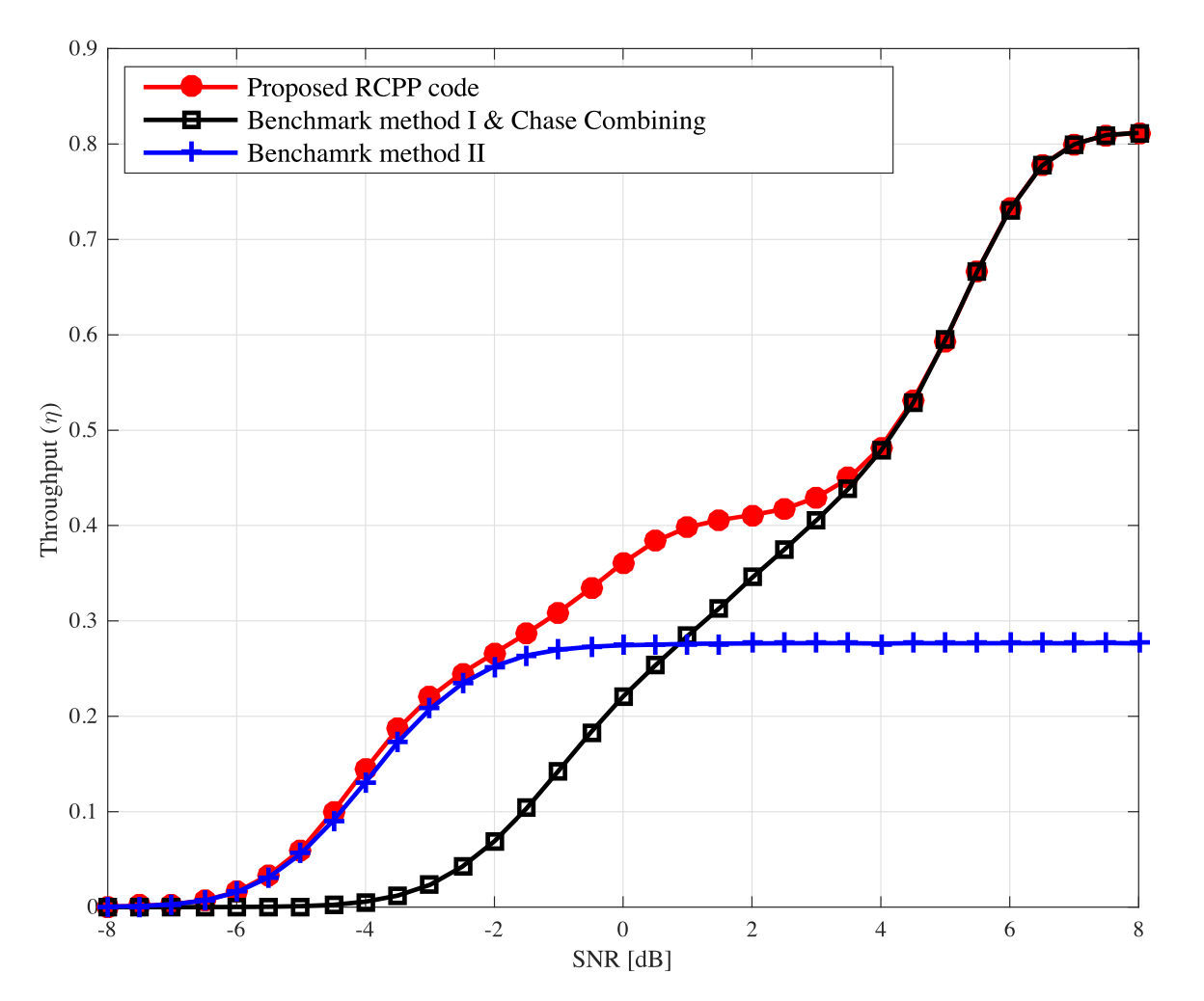
The length of polar code is $2^k$ with $k\in\mathbb{N}$ due to its recursive construction based on $2\times 2$ Arıkan kernel. In order to for polar code to be rate-compatible, we studied and designed puncturing/shortening methods of polar code for the IR-HARQ scheme. Specifically, we proposed the RCPP code for IR-HARQ scheme and showed that it performs well in both low and high SNR regime.
The simulation result of throughput for various IR-HARQ schemes (including our proposed algorithm) can be viewed in the plot. For details, see “An Efficient Construction of Rate-Compatible Punctured Polar (RCPP) Codes Using Hierarchical Puncturing”.
2. Efficient decoding of polar codes
Again, focusing on increasing throughput of polar codes, we investigated various decoding algorithms such as list decoding, tree-structured SC decoding (e.g., simplified SC, Fast SSC, SCFlip, etc.), message passing based decoding, deep learning based decoding (e.g., DNN decoding, RNN decoding), and sequential decoding. The goal of this research was to design low complexity and high performance decoding algorithm.
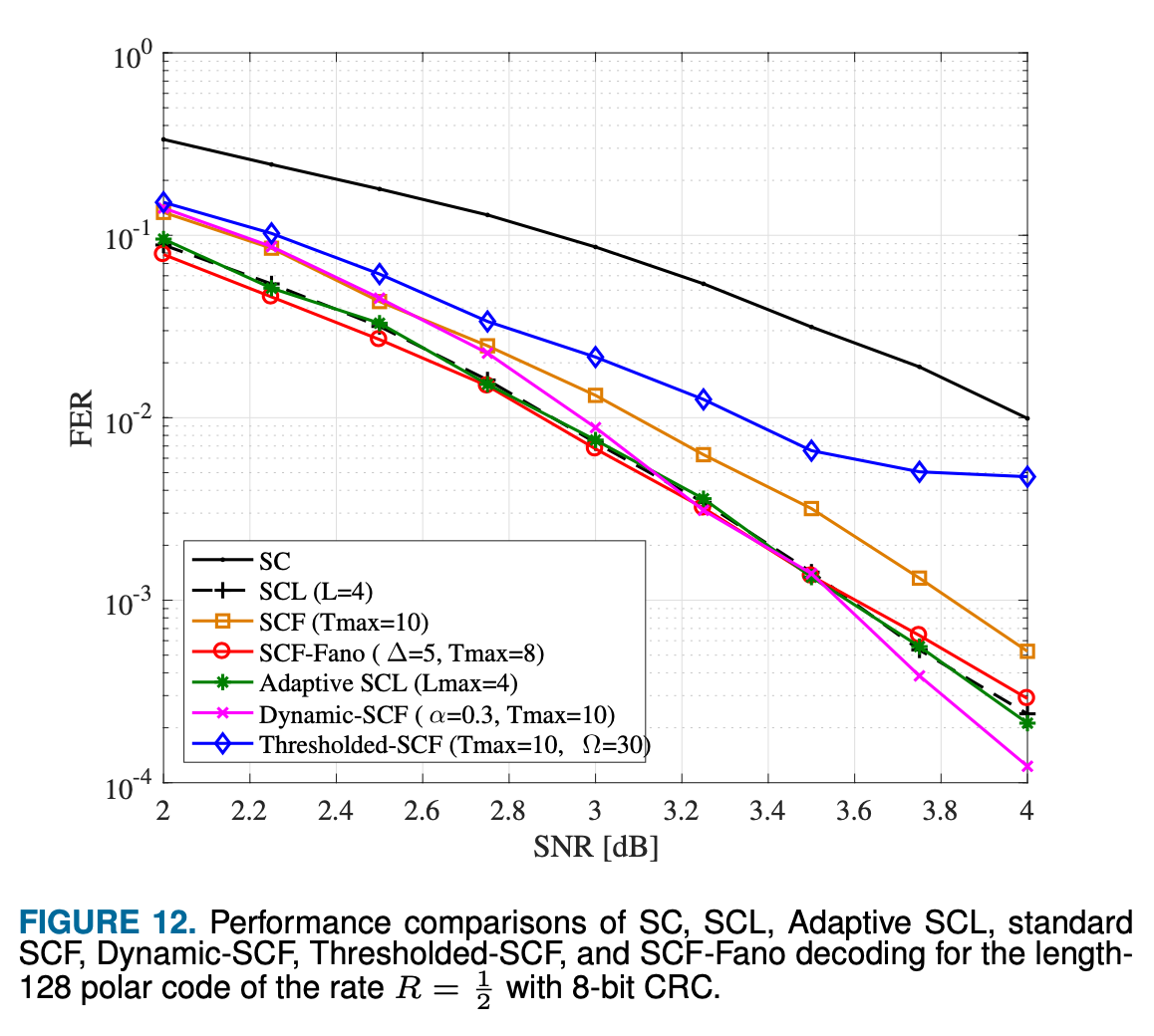
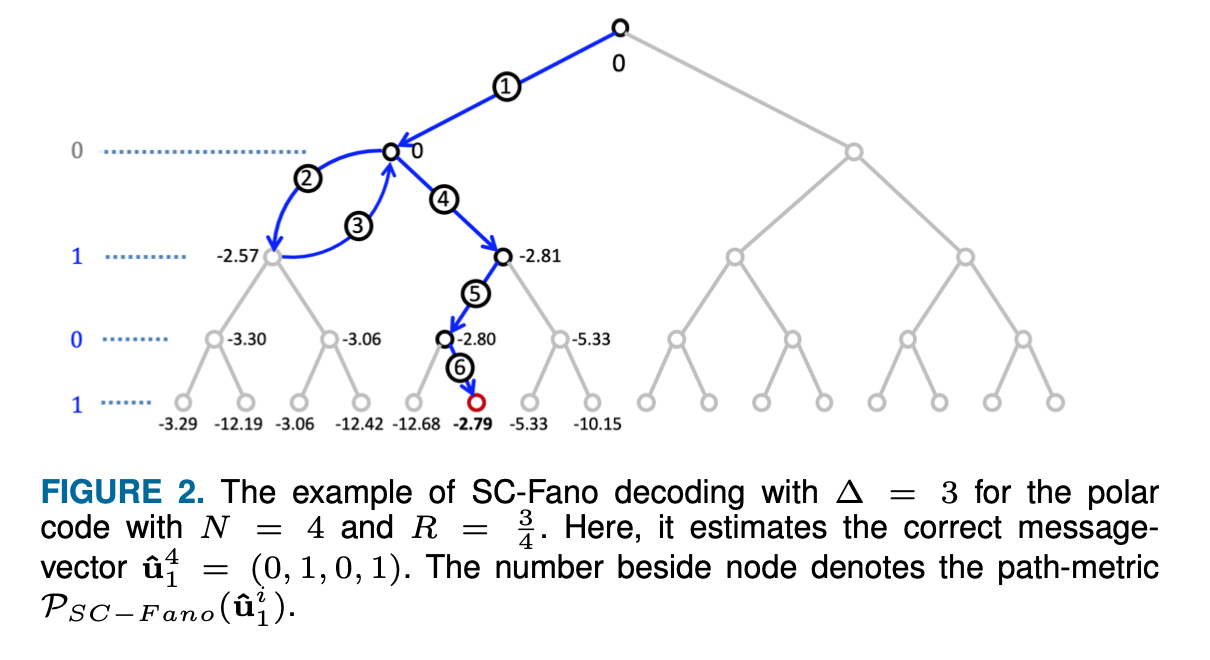
As a result, we proposed a sequential decoding algorithm by incorporating SC decoding with Fano sequential decoding, which we called SC-Fano decoding. The idea came from the fact that decoding error of polar code usually happens by one bit error, which means if we correct the one bit error, the decoding would succeed. To this end, we applied the heuristic sequential decoding algorithm and showed that the proposed algorithm performs well. The simulation result can be viewed in the plot. For details, see “SC-Fano Decoding for Polar Codes”.